
Poker Hands
Poker Hand Rankings Chart
In the traditional ranking system, poker hands rank from royal flush at the top down to high card at the bottom. The highest-ranked hand at showdown wins the pot.
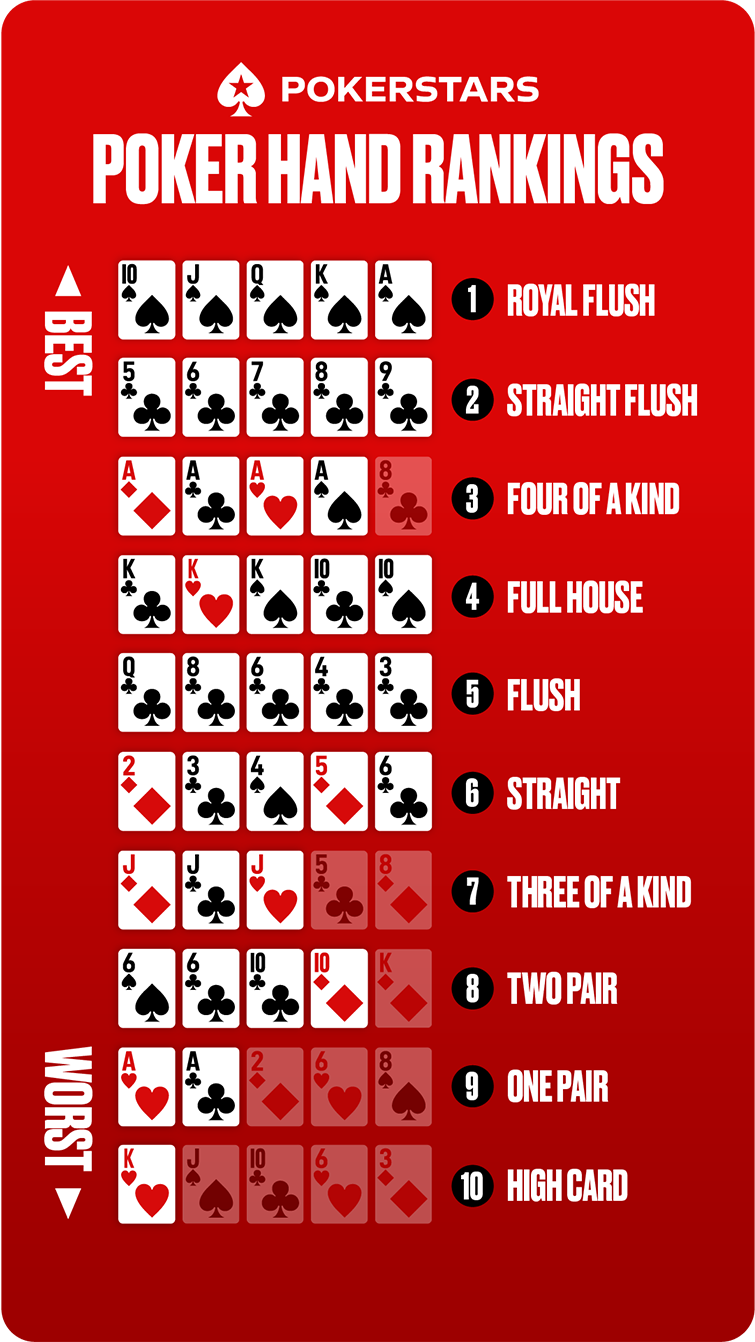
Download the poker hand rankings chart.
The poker hand rankings in order from highest to lowest are royal flush, straight flush, four of a kind, full house, flush, straight, three of a kind, two pair, one pair and high card.
Traditional Poker Hand Ranks
This is the standard ranking system, as used in Texas Hold’em. Each section below gives a description of the hand, the hands it beats and how a tie is settled. Use the links to jump to a specific hand:
| 1. Royal flush | 2. Straight flush |
| 3. Four of a kind | 4. Full house |
| 5. Flush | 6. Straight |
| 7. Three of a kind | 8. Two pair |
| 9. One pair | 10. High card |
1. Royal Flush
What is a royal flush? A royal flush is an ace, king, queen, jack and ten all of the same suit. It is the highest hand in poker. An example is 10♠ J♠ Q♠ K♠ A♠.
What does a royal flush beat? A royal flush beats all other hands at showdown. It loses to nothing and cannot be beaten.
Who wins if more than one player has a royal flush? Two royal flushes are equal in rank. In Texas Hold'em, two different royal flushes are impossible, but if a royal flush forms across the community cards, it results in a split pot at showdown.

2. Straight Flush
What is a straight flush? A straight flush is five consecutive cards, all of the same suit. An example is 5♣ 6♣ 7♣ 8♣ 9♣.
What does a straight flush beat? A straight flush beats four of a kind and below. The highest possible straight flush is an ace high straight flush, also known as a royal flush.
Who wins if more than one player has a straight flush? The straight flush with the highest top card wins. If both have the same top card, the pot is split, which in Texas Hold'em is only possible if it forms on the community cards.

3. Four of a Kind
What is four of a kind? Four of a kind is four cards of the same rank, with a fifth card acting as the kicker. An example is A♦ A♣ A♥ A♠ 8♣.
What does four of a kind beat? Four of a kind beats a full house and below. It loses to a straight flush and royal flush.
Who wins if more than one player has four of a kind? The higher set of four cards wins. In Texas Hold'em, if two players hold four of the same rank on a shared board, the higher kicker decides who wins.

4. Full House
What is a full house? A full house is three cards of one rank and two cards of another. An example is K♣ K♥ K♠ 10♣ 10♠.
What does a full house beat? A full house beats a flush and below. It loses to four of a kind and above.
Who wins if more than one player has a full house? The higher three of a kind wins. If both players have the same three of a kind (like on a shared board in Texas Hold'em), the higher pair decides the pot.

5. Flush
What is a flush? A flush is five cards of the same suit that don't run consecutively. An example is Q♣ 8♣ 6♣ 4♣ 3♣.
What does a flush beat? A flush beats a straight and below. It loses to a full house and above.
Who wins if more than one player has a flush? The flush with the higher top card wins. If the top cards match, the next highest card decides, and so on.

6. Straight
What is a straight? A straight is five cards of consecutive rank, and not of the same suit. An example is 2♦ 3♣ 4♠ 5♦ 6♣.
What does a straight beat? A straight beats three of a kind and below. It loses to a flush and above.
Who wins if more than one player has a straight? The highest straight wins. If both straights are the same, the pot is split.

7. Three of a Kind
What is three of a kind? Three of a kind is three cards of the same rank with two unmatched cards. An example is J♦ J♣ J♥ 5♣ 8♦. It can be referred to as 'trips' or a 'set' depending on how the three of a kind is formed.
What does three of a kind beat? Three of a kind beats two pair and below. It loses to a straight and above.
Who wins if more than one player has three of a kind? The higher set of three cards wins. If they are shared, as community cards, then the higher kicker decides the pot.

8. Two Pair
What is two pair? Two pair is two cards of one rank, two cards of another rank and a fifth card as the kicker. An example is 6♠ 6♣ 10♣ 10♦ K♦.
What does two pair beat? Two pair beats one pair and below. It loses to three of a kind and above.
Who wins if more than one player has two pair? The highest pair wins. So, a two pair of aces and jacks beats kings and queens. If the highest pair is shared, the second pair decides, and if both pairs match, the higher kicker is used.

9. One Pair
What is one pair? One pair is two cards of the same rank with three unmatched cards. An example is A♥ A♣ 2♦ 6♥ 8♠.
What does one pair beat? One pair beats high card only. It loses to two pair and above.
Who wins if more than one player has one pair? The highest pair wins. If both hold the same pair, the highest kicker decides, if that is equal then the next highest kicker decides, and so on.

10. High Card
What is a high card? High card is five unmatched cards containing no pair, straight or flush, ranked by the highest card. An example is K♥ J♠ 10♣ 6♥ 3♦.
What does a high card beat? High card beats nothing. It is the lowest hand and loses to all other hands at showdown.
Who wins if more than one player has a high card? The highest card wins, if those are equal, the next highest card decides the pot, and so on.

How Poker Hand Rankings Work
In most poker formats, a poker hand is the best five-card combination a player can make. In Texas Hold'em, each hand is formed using two private hole cards and five shared community cards, the strongest five cards of those seven make the hand. The role of hand rankings is to determine which hands beat which when they are compared at showdown. The order is related to the probability of each hand occurring. The rarer the hand, the higher it ranks, so the least frequent royal flush sits at the top. In Texas Hold'em, a flush appears less often than a straight, so a flush ranks above a straight. The standard rules on how a poker hand is played can be found on the main poker rules page.
How Poker Hands Are Compared
First, poker hands are compared by category. A hand in a higher category always beats a hand in a lower category at showdown in most poker formats. So, any flush beats any straight and any full house beats any flush. If more than one hand at showdown fall into the same category, the values within the hand determine the winner. For a flush, the highest card is compared first, then the next, and so on. For three of a kind, the rank of the three matching cards is compared before any other card.
Ties, Kickers and Split Pots
A kicker is a card that is not part of the main combination but decides a tie between hands in the same category. If two players hold the same pair, the highest remaining card acts as the kicker to decide who wins. If the first kickers match, the next kicker is compared, and so on. If all five cards are equal between opponents, then a split pot occurs which means the pot is distributed between the winners. Here's an example of the kicker being decisive: one player's best five cards is A♠ A♦ K♣ Q♠ 9♥ and another holds A♣ A♥ K♦ Q♣ 8♠. Both have a pair of aces with a king and a queen, so the fifth card is compared, and the 9♥ beats the 8♠ to win the pot.
Hand Rankings Across Variants
Some poker variants have different hand rankings compared to standard high-hand poker. In Razz rankings the lowest hand wins and straights and flushes do not count against a low hand, the best hand is 5-4-3-2-A, also known as a wheel. The lowest hand also wins in 2-7 Triple Draw rankings and 2-7 Single Draw rankings but straights and flushes count against the value of a hand and the ace is always high. In Short Deck rankings (including 6+ Hold'em), the deck of 36 cards has the twos, threes, fours and fives removed, leaving cards six to ace, this makes a flush less likely than a full house and therefore ranks above it. In Badugi rankings the best hand is four low cards of different suits and different ranks, 4-3-2-A. Each specific variant page goes into more detail about their rankings.
Frequently Asked Questions About Poker Hand Rankings
The traditional poker hands in order from highest to lowest are royal flush, straight flush, four of a kind, full house, flush, straight, three of a kind, two pair, one pair and high card. A royal flush is the strongest hand and high card is the weakest. The highest-ranked hand at showdown wins the pot. These hand rankings are used in popular poker formats such as Texas Hold’em, Omaha, Seven Card Stud and Five Card Draw. It’s also used to rank the 'high' hands in Hi/Lo variants.
Each poker hand beats the hands below it in the ranking at showdown. A royal flush beats all hands. A straight flush beats four of a kind and below. Four of a kind beats a full house and below. A full house beats a flush and below. A flush beats a straight and below. A straight beats three of a kind and below. Three of a kind beats two pair and below. Two pair beats one pair and below. One pair beats high card, which beats nothing. The pot can also be won before showdown if all opponents fold.
The highest hand in poker is the royal flush but it is rare. A royal flush is an ace, king, queen, jack and ten all of the same suit. It beats all hands and loses to nothing. A split pot can occur in games like Hold'em where the royal flush can form across the shared community cards.
When two players hold the same category of hand, the higher card values determine the winner. For a pair, if the players have the same pair, then the highest remaining card, called the kicker, settles the hand, and if kickers match the next card is compared. If both hands are equal across all five cards, it results in a split pot.
Suits do not rank against each other in standard poker, so no suit is worth more than another. Suits are relevant only when it comes to forming a hand, such as a flush or a straight flush, where all cards must share one suit. When two flushes are compared, the rank of the cards are compared, not the suits.